 Bridging News
How Are Tongnan Lemons Powering Their Global Journey in the March–May Peak Season? | Invisible Economics
Chongqing - As lemon demand rises across Southeast Asia, a simple cup of lemonade on a busy street can be traced back through a supply chain to Tongnan in southwest China’s Chongqing, a key hub for China’s lemon exports that is now making full use of the March-to-May export window.
Though inland and far from any border, Tongnan has built a lemon industry that links orchards, cold storage, processing plants, and shipping routes to consumers across Asia.
That rise is driven by scale. Tongnan has about 233 square kilometers of lemon plantations, an annual fresh-fruit output of 280,000 tons, and an annual processing capacity of 150,000 tons. The region mainly grows Eureka lemons, a widely traded variety known for high yield, stable flavor, and long storage life. With that production base, Tongnan is now regarded as one of the world's leading lemon-producing regions, alongside California and Sicily.
For Xuewang Agriculture, a subsidiary of the Chinese beverage chain Mixue Ice Cream & Tea, Tongnan is more than just a growing area. It is a strategic control point.
Li Jincheng, deputy general manager of Xuewang Agriculture (Chongqing) Co., Ltd., said the company moved upstream into fresh-fruit sourcing for three reasons: limited storage and production capacity at origin factories, the risk created by price swings, and the need for tighter control over pesticide residues. He said the Tongnan factory now accounts for more than 70% of the company's processing and storage capacity and supplies most of its fresh-fruit raw materials. "Here is our heart," he said.
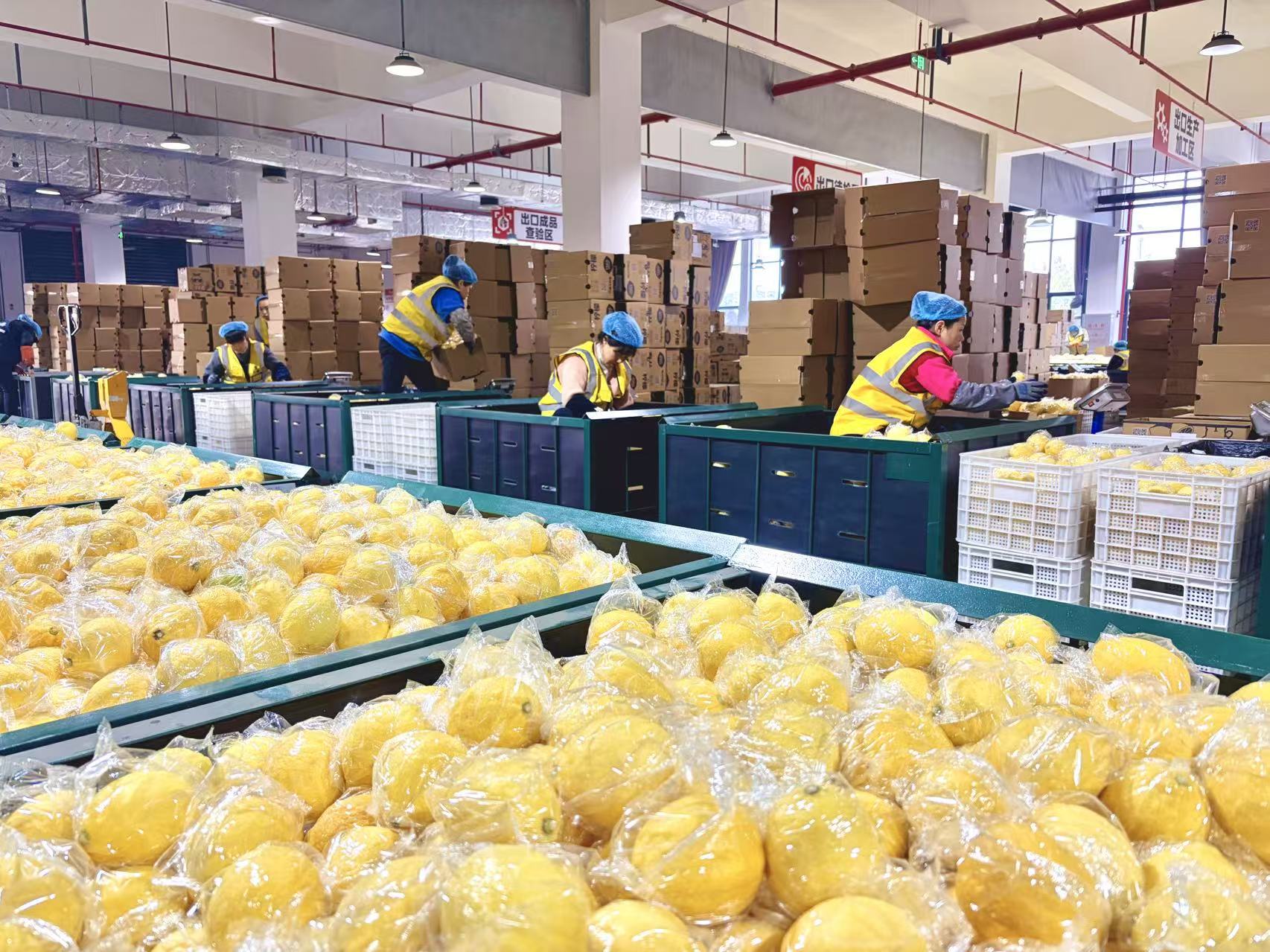
The factory of Xuewang Agriculture (Chongqing) Co., Ltd. (Photo/Zheng Ran)
Inside the factory, that strategy becomes visible in the form of strict screening and industrial precision. Wang Fangyi, a packaging worker, said daily throughput ranges from about 50 tons in the off-season to as much as 250–350 tons during peak production.
Workers sort lemons by hand and by appearance, removing fruit with black spots, skin damage, or rot. In export markets, even small cosmetic defects can shape consumer perception. Wang said many of the lemons processed in Tongnan are shipped to Southeast Asia, including Thailand, Malaysia, and Vietnam.
The export story also runs through growers such as Hu Zaiyang, general manager of Chongqing Leishu Fruit Co., Ltd. Hu said his father has grown lemons for more than 20 years, while he himself entered the business in 2019 after leaving construction.
He described 2021 as a turning point: the fruit met export standards, but orders were missing. He said the breakthrough came after joining a Chongqing government-organized overseas trade promotion program, which helped the company secure its first shipment to Vietnam in 2023.
Timing gives Tongnan another advantage. Lemons harvested in November and December can be stored in smart cold warehouses and sold into the following spring, creating a window from March to May when competitors from Türkiye and Egypt are past peak season, and suppliers from South Africa and Argentina have yet to fully enter the market.
Hu said shipments to Manila take about 12 days through combined road and sea cold-chain transport. Li said Southeast Asian buyers favor Chinese lemons for their stable acidity, consistent flavor, and long supply season, which can extend to 11 or 12 months.
From an inland district in western China, Tongnan has turned a single yellow fruit into a cross-border business story of agriculture, logistics, and export resilience.
 Related Stories